

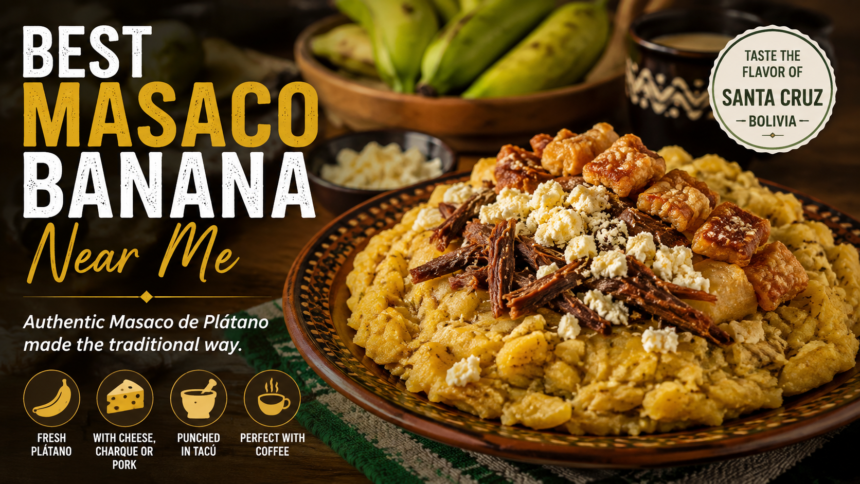
If you are searching for the best masaco banana near me, use the dish’s Spanish name as well: masaco de plátano. That small change can produce much better local results.
Masaco de plátano is a traditional food associated with Santa Cruz and the cuisine of eastern Bolivia. A typical version starts with cooked or fried plátano that is pounded and mixed with ingredients such as cheese, charque (dried meat), meat or chicharrón. Santa Cruz’s municipal Culture and Tourism department describes versions made with green, partially ripe or ripe plátanos and notes that the dish is traditionally associated with coffee, particularly the regional custom of café de la siesta.
Finding it outside Bolivia can require more effort than finding better-known Bolivian dishes. The reason is not simply a lack of restaurants: masaco is also strongly connected with home cooking. That means the best local search strategy is to look beyond the exact English phrase “masaco banana” and search for the dish, its variations and the cuisine it belongs to.
The quickest way to find good masaco near you
Start with these searches, replacing the location with your town, city or neighbourhood:
- masaco de plátano near me
- masaco de plátano + [city]
- masaco con charque + [city]
- masaco con queso + [city]
- Bolivian restaurant + [city]
- comida cruceña + [city]
- comida camba + [city]
- Santa Cruz Bolivian food + [city]
Searching only for “banana masaco” can miss relevant menus because restaurants serving the dish are much more likely to use its Spanish name.
Once you find a possible restaurant, café or Bolivian food business, check its recent menu and social-media posts before travelling. Masaco may appear as a breakfast, snack or special rather than a permanent main course. Calling ahead is particularly useful if you want a specific version such as masaco with charque or masaco with cheese.
What is masaco de plátano?
The basic idea is simple: plátano is softened through cooking or frying and then pounded into a cohesive mixture with savoury ingredients.
An official Santa Cruz municipal recipe uses six ripe plátanos and queso criollo. The fruit is sliced, fried, drained and then pounded in a tacú, with the cheese gradually incorporated. The same municipal guide says other versions can use green, partly ripe or fully ripe plátanos and can be combined with meat, charque or chicharrón.
Another Bolivian recipe source describes a version using ripe plátanos and charque, while noting that the fruit may also be fried instead of boiled and that green and ripe plátanos can be mixed.
This flexibility matters when choosing where to eat it. Two genuine versions of masaco can taste noticeably different without either being inherently wrong.
Is “masaco banana” actually made with banana or plantain?
The English terminology is less precise than the Spanish menu name.
The FAO distinguishes sweet dessert bananas from cooking bananas and plantains, noting that plantain varieties remain comparatively starchy and are normally cooked. Bananas and plantains can also be used at green, partially ripe or fully ripe stages depending on the preparation.
For a local restaurant search, masaco de plátano is therefore much more useful than trying to decide whether an English menu should translate plátano as “banana” or “plantain.”
What should good masaco taste and feel like?
There is no single official scoring system for the “best” masaco, but traditional preparation gives you several practical things to look for.
The plátano should form the body of the dish rather than simply appearing as separate fried slices. Pounding is central to the preparation: Santa Cruz municipal sources describe the cooked or fried ingredient being worked in a tacú until it becomes a mass that can be served in portions.
A good version should also avoid being unnecessarily oily. In a published account of traditional masaco preparation at a Santa Cruz tea room, the cooks stressed draining the fried ingredients thoroughly and cooking the pork until properly browned before combining it with the plátano.
Beyond that, the flavour depends heavily on which style you order.
Masaco with cheese
Masaco con queso combines the natural sweetness or starchiness of the plátano with salty cheese. The Santa Cruz municipal recipe gradually mixes queso criollo into fried ripe plátano while it is being pounded.
This is the version to look for if you do not want charque or pork, although anyone following a vegetarian diet should still ask the restaurant whether meat fats or shared cooking equipment are used.
Masaco with charque
Charque adds a concentrated salty, meaty flavour. Recipes may soften and shred the dried meat before combining it with the plátano, while other preparations fry it for additional texture.
If a menu simply says “masaco,” ask which meat or cheese is used rather than assuming.
Masaco with chicharrón
Pork versions are richer. One documented Santa Cruz preparation combines fried ripe plátano with crisp chicharrón and pounds the two together in the tacú.
Green versus ripe plátano
Ripeness changes the dish considerably.
A green plátano produces a starchier, less sweet result. A ripe one brings more sweetness and a softer texture. Santa Cruz’s official description explicitly allows green, pintón—partially ripe—or mature plátano, so ripeness is a variation rather than a simple test of authenticity.
If you already know you prefer savoury food with very little sweetness, asking whether the kitchen uses green or ripe plátano can save you from ordering the wrong style.
Why masaco can be surprisingly hard to find on restaurant menus
One of the most useful clues comes from Santa Cruz itself.
A 2021 study by the Instituto Cruceño de Estadística (ICE) surveyed 200 residents aged 14 or older in metropolitan Santa Cruz using a non-probability quota sample. Among the purchasing locations reported for masaco, 40% said it was prepared at home, while 30% obtained it from tea rooms, snacks, kiosks or supermarkets. Smaller shares cited bakeries or neighbourhood shops, markets and other venues.
The study should not be treated as a precise estimate for every Bolivian household—the authors themselves describe the sampling method and its limitations—but it explains an important point for a “near me” search: masaco is not exclusively restaurant food.
That is why searching only conventional restaurant menus may miss it.
Bolivian cafés, tea rooms, bakeries, snack businesses and places specialising in comida cruceña can be worth checking alongside full-service restaurants.
How to tell whether a listing actually serves masaco
Do not rely on a restaurant being labelled simply “Latin American.” Bolivia has a distinct regional food culture, and even a genuinely Bolivian restaurant may concentrate on dishes from regions where masaco is less prominent.
Before making a special trip, look for at least one of these signs:
- The menu specifically mentions masaco or masaco de plátano.
- The business describes its food as cruceño, camba, oriental Bolivian or associated with Santa Cruz.
- Recent menu photos show mashed or pounded plátano combined with cheese, charque or pork.
- The restaurant can tell you whether it uses green or ripe plátano and what is mixed into it.
- Staff can confirm whether masaco is available that day rather than simply offering fried plantain as a substitute.
Plain fried plantain is not masaco. The pounding and incorporation of the other ingredients are fundamental to the dish described in traditional Santa Cruz sources.
The tacú is more than a decorative detail
Traditional masaco is closely connected with the tacú, a substantial wooden mortar used to pound ingredients.
Santa Cruz’s municipal cultural publication describes the traditional method as pounding cooked yuca or plátano in the tacú until a mass forms. The city’s dedicated masaco recipe similarly instructs cooks to transfer the fried plátano to the tacú before incorporating cheese.
A restaurant obviously does not need to put a wooden mortar on your table for the finished dish to be enjoyable. What matters is the technique it represents: masaco is a pounded preparation, not merely sliced banana or plantain served beside meat.
That distinction is especially helpful when interpreting English-language menu descriptions.
Masaco de plátano is not the same as masaco de yuca
If a search result says only “masaco,” check the base ingredient.
Masaco can also be made with yuca, and Santa Cruz municipal material describes both yuca and plátano preparations. Other versions may incorporate cheese, charque or pork.
Masaco de yuca is worth trying, but it is not a direct substitute if what you specifically want is the plantain version.
Similarly, sonso is another traditional eastern Bolivian preparation involving yuca and cheese, but it is a different food. Search engines and broad “Bolivian food near me” lists can blur these distinctions, so reading the actual menu description matters.
What to ask before ordering
If you have found a promising place, four questions can quickly tell you what kind of masaco you are getting:
“Is the masaco made with plátano or yuca?”
“Do you use green or ripe plátano?”
“Is it made with cheese, charque or chicharrón?”
“Is it available today?”
Those questions are more useful than asking whether the restaurant makes the dish in the one “correct” way, because documented Santa Cruz recipes themselves show considerable variation.
If you have allergies or dietary restrictions, also ask directly about cheese, meat, pork fat, peanuts, cooking oil and cross-contact. Do not assume a dish is vegetarian, dairy-free or allergen-free from the word plátano alone.
The most effective search for “best masaco banana near me”
The practical answer is to search for the food by its real menu name:
masaco de plátano + your location
Then broaden the search to masaco con queso, masaco con charque, comida cruceña, comida camba and Bolivian restaurants.
The strongest candidate is not necessarily the restaurant with the highest overall review score. For this particular search, a more useful sign is that the kitchen actually knows the dish, identifies the version it serves and prepares the plátano as a pounded mixture rather than passing off ordinary fried plantain as masaco.
Once you find that, decide which style suits you: sweet-savoury ripe plátano with cheese, a saltier charque version, a richer preparation with chicharrón, or the starchier character of green plátano.
Sources
- Secretaría Municipal de Cultura y Turismo, Gobierno Autónomo Municipal de Santa Cruz de la Sierra — “Masaco.” No publication date displayed on the opened page. Official Masaco page
- Gobierno Autónomo Municipal de Santa Cruz de la Sierra — Locro e’ letras. 2022. Municipal publication PDF
- Instituto Cruceño de Estadística (ICE) — Hábitos de consumo de comidas típicas en Santa Cruz. 2021. ICE study PDF
- Food and Agriculture Organization of the United Nations — “Bananas and plantains,” in Traditional post-harvest technology of perishable tropical staples. Publication date not displayed on the opened chapter. FAO chapter
- Recetas.com.bo — “Masaco de plátano.” Publication date not displayed on the opened page. Masaco de plátano recipe
- Sabores de Bolivia — “Tome apuntes: le damos la receta del masaco de plátano y de yuca.” 28 May 2026. Sabores de Bolivia article